
Patta Chitta TN 2026 | நில விவரம் ,Land Records Check Online
PattaChitta is an online land record available on the Tamil Nadu e-Services Portal that helps citizens quickly verify land ownership and property details such as survey number, type, and location, while also supporting services like Patta transfer and document verification.
Check patta chitta Tamil Nadu online in 2026.Learn how to verify documents ,view land records, ownership status, and property details quickly with this simple step.
Only use the official website to keep your information secure. Do not share your Aadhaar details, enrollment number, or personal information on any fake/malicious websites.
What Is Patta Chitta in Tamil Nadu?
In Tamil Nadu, Patta Chitta is a digital land record that confirms ownership and land classification. Patta includes the owner’s name, survey number, and tax details, while Chitta shows whether the land is wet (Nanjai) or dry (Punjai). These records were merged to simplify land verification and make property management easier for citizens.

Patta Chitta Benefits
Accessing land records online is quick and easy, offering a time-saving process that eliminates the need for physical visits. The documents you retrieve are legally recognized and valid for official use. Additionally, the eco-friendly digital option reduces paper usage, while secure downloads ensure your records are official and protected.
Go to the Tamil Nadu e-Services portal at tnesevai.tn.gov.in or the dedicated land records section.
Choose Patta Chitta or related land record options from the menu.
Select your District, Taluk, and Village from the dropdown lists.
Enter either your Survey Number, Patta Number, or Owner Name. Solve the captcha to proceed.
Your Patta Chitta document will appear on screen. You can download or print it for official use.
Types and Key Information in Patta Chitta
Patta Chitta includes:
UDR Patta
Digitally updated record showing current ownership and survey details.
Manual Patta
Pre-digital, handwritten records of land ownership.
Joint Patta
Issued for land owned by multiple individuals collectively.
2C Patta
Covers lands under specific government or community control.
TSLR Extract
For urban plots listed under the Town Survey Land Register.
Natham Patta
Residential plots in rural or village areas.
AD Condition Patta
Issued under welfare schemes with specific conditions attached.
Land Handover Patta
For lands allocated by the government.
For proper legal documentation and to resolve any issues with Joint Patta,it’s important to regularly update the records and verify details with the local authorities. Learn more about Joint Patta and how to manage joint land ownership on our website.
The 2015 Merger: Combining Patta and Chitta
In 2015, Tamil Nadu combined Patta and Chitta into Patta Chitta, a single digital record merging ownership and land classification. This reduces errors, provides secure online access, and serves as legal proof for transactions, loans, inheritance, and dispute resolution.
Who Is Eligible To Apply For Patta Chitta
|
Eligibility |
Details |
|
Eligible to Apply |
Registered owners via sale, gift, or partition; legal heirs with inheritance documents; joint owners for Joint Patta; beneficiaries under government schemes; correction of clerical errors. |
|
Not Eligible to Apply |
Land under active court disputes; unregistered sale deeds; invalid or unverified survey numbers; government-owned or water body land. |
Legal Value of Patta Chitta in Courts
|
Aspect |
Details |
|
Legal Recognition |
Strong supporting document in courts, but not absolute proof of ownership. |
|
Possession Proof |
Establishes possession and revenue recognition of the land. |
|
Land Classification |
Verifies whether land is wetland (Nanjai) or dryland (Punjai). |
|
Civil Cases |
Supports civil claims, injunctions, and other property-related cases. |
|
Inheritance Disputes |
Assists in resolving disputes related to inheritance or succession. |
|
Used With Other Documents |
Often combined with sale deeds, EC, and survey reports for stronger legal validity. |
Patta Chitta Services
|
Aspect |
Details |
|
Portal Name |
Patta Chitta – Official digital land record of Tamil Nadu |
|
Launched By |
Tamil Nadu Revenue Department and the Commissionerate of Survey and Settlement |
|
Purpose |
Provides legal proof of land ownership and ensures transparent land record management |
|
Key Information |
Owner name, Patta number, survey & subdivision numbers, land area, land type (wet/dry/Natham), district, taluk, village, and tax details |
|
Importance |
Required for property buying/selling, bank loans using land as collateral, dispute resolution, and building approvals |
|
Official Website |
Tamil Nadu e-Services Portal for viewing, verifying, and downloading Patta Chitta online |
Patta Chitta:
Patta Chitta is an official land ownership record issued by the Tamil Nadu Revenue Department.
Importance:
It confirms property ownership and shows the legal status of the land.
Online Check:
You can view Patta Chitta online through the Tamil Nadu e-Services Portal.
Main Uses:
It is used for ownership verification, land disputes, and property sale or purchase.
Aadhaar Link:
It can be linked with Aadhaar for secure identity verification and easy record handling.
Apply Online:
Patta transfer and updates can be submitted online for a faster and paperless process.
How to Apply for Patta Transfer Online
Transfer Patta online via the Tamil Nadu e-Services portal by filling in details, uploading documents, and paying the fee. Track your request with the application ID.
Open the Tamil Nadu e-Services website provided by the Government of Tamil Nadu.
Sign in with your existing account or create a new user profile on the portal.
For fixing login issues,go on website.
Choose the “Apply Online Patta Transfer” option under land services.
Enter applicant details, current owner information, and property details such as district, taluk, village, and survey number.
Attach documents like the sale deed, encumbrance certificate, proof of possession, and identity proof such as Aadhaar Card or voter ID.
Complete the online payment for the nominal Patta transfer charge.
Review the form and uploaded documents, then submit the request.
After submission, an application reference number is generated for tracking.
Use the application ID on the portal to check the progress of your Patta transfer request.
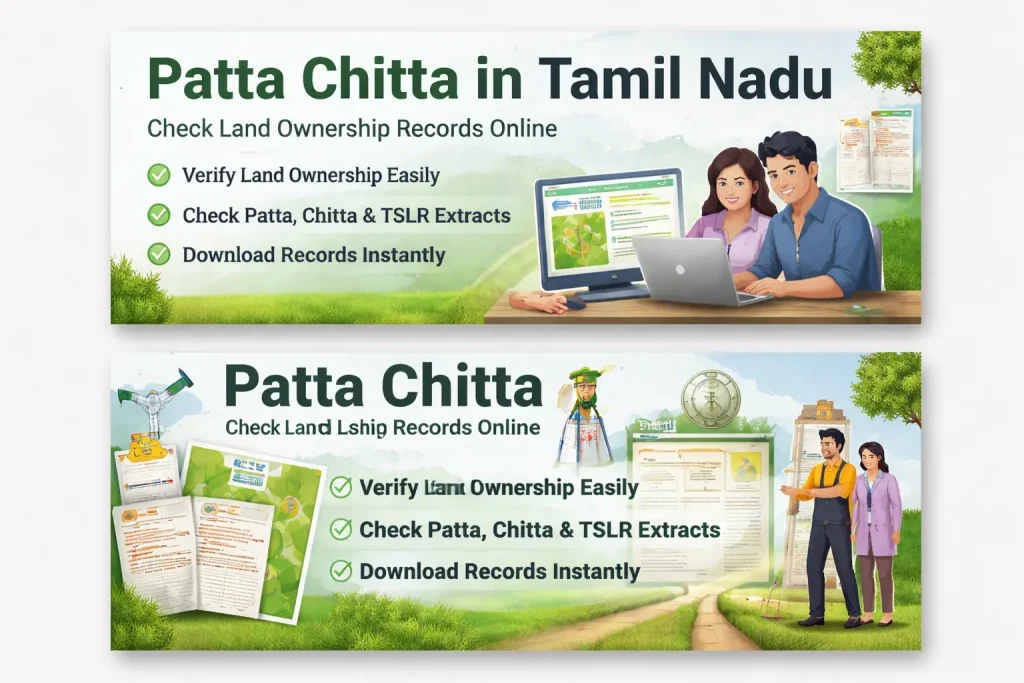
How to patta download online (Rural or Natham Land)
Easily transfer Patta online on the Tamil Nadu e-Services portal by filling in your details, uploading documents, and paying the fee. Use the application ID to track your request.
Visit the Tamil Nadu e-Services portal of the Government of Tamil Nadu.
Click on “View Patta/Chitta” and choose the land type (Rural or Natham).
Enter location details such as district, taluk, and village.
Provide the Patta number or survey number with subdivision details.
Verify using OTP sent to your mobile number.
View, download, or print your Patta Chitta record online.
Processing Time for Land Records
|
Aspect |
Details |
|
Processing time |
Varies based on type of request and documentation |
|
New Records / Transfers |
15–30 working days if documents are complete |
|
No Subdivision Cases |
Typically 15–20 working days |
|
Field Inspections / Corrections |
May extend beyond 30 days |
|
Land Disputes |
Processing can exceed 30 days depending on complexity |
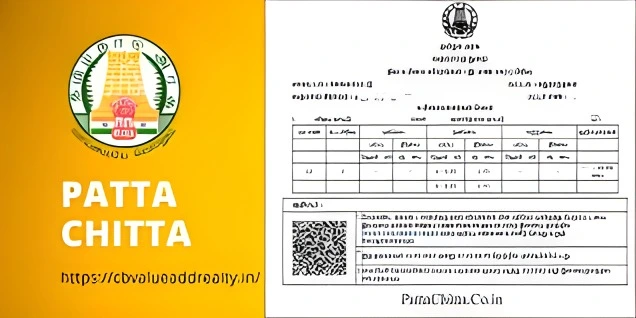
Required Documents for Patta Chitta Online Application
For Patta Chitta online application, submit documents like the sale deed, EC, proof of possession, Aadhaar, previous Patta, and NOC or court orders. Processing takes 15-30 days.
Issued by: Tamil Nadu Revenue Department
Portal: Tamil Nadu e-Services Portal
Purpose: Legal proof of land ownership, dispute resolution, property transactions, and loan approvals
Processing Time: 15–30 days (varies by request)
Aadhaar Linked: For secure identity verification
Required Documents: Sale/gift/inheritance deed, EC, possession proof, ID, previous Patta, NOC/court orders if applicable
Real-Life Example of Joint Patta Chitta
For example, two brothers, Ravi and Kumar, inherit farmland from their father. After mutation of records, both names are added in the Patta Chitta, and the land becomes jointly owned.Now, Ravi wants to sell his share of the land. However, he cannot sell it independently because the property is still under Jointownership. He must either take Kumar’s permission or first apply for land partition to divide the property legally.
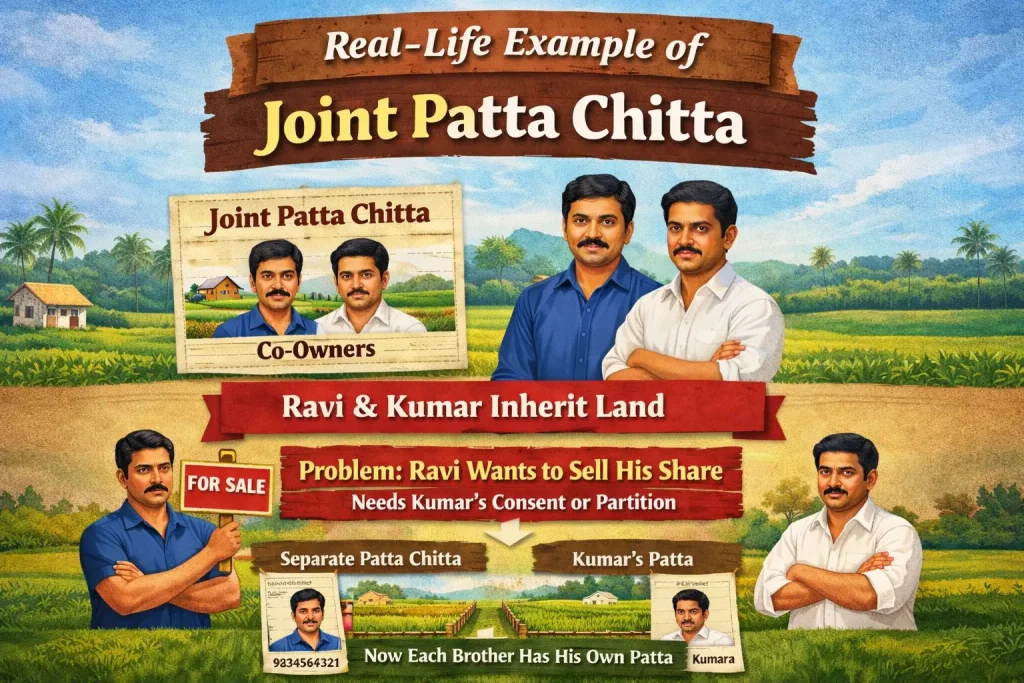
After completing the partition process, the revenue department updates the records, and both brothers receive separate Patta Chitta documents, each showing individual ownership. This example clearly explains how Joint Patta Chitta works in real life, why co-owners must agree before selling land, and how separation of records helps avoid property disputes in Tamil Nadu land records system.
Common Problems and Solutions with Patta Chitta
Problem: Delays in Patta Chitta Application
Solution:
To avoid delays, ensure all documents are correctly submitted, including sale deeds, identity proof, and property records. Regularly check the status online to track progress and ensure there are no pending issues.
Problem: Incorrect Land Details in Patta Chitta
Solution:
If discrepancies arise, visit the Taluk office with proof (e.g., sale deed or tax receipts) to request corrections. You can also use the online correction service provided by Tamil Nadu’s e-Services portal.
Problem: Patta Name Mismatch
Solution:
To resolve a name mismatch, submit an application with necessary documents like a marriage certificate or legal heir certificate for name change after marriage or death.
correct Patta Chitta , a crucial land record in many states, is used to verify land ownership and details.
How to Verify Your Patta Chitta Online (Rural or Natham Land)
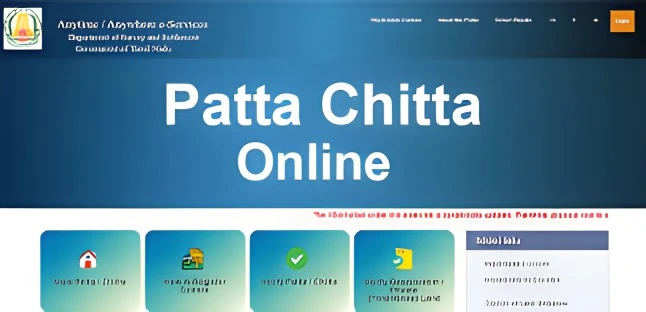
To verify your Patta Chitta, visit the Tamil Nadu e-Services portal, enter your Patta number, receive and submit the OTP. Optionally, check your application status. Cross-check details with government records.
Go to the Tamil Nadu e-Services Portal.
Click on “Verify Patta/Chitta” or “Verify Web-Issued Patta/Chitta.”
Input the unique number on your Patta Chitta.
Receive an OTP for verification.
Type the OTP sent to your mobile.
Click “Submit” to confirm authenticity.
Enter Application ID and captcha in “Application Status.”
Cross-check details like Patta Number, District, Taluk, and Village with government records.
Fees on Tamil Nadu Patta Chitta Online Portal
|
Service |
Fee (Approx.) |
|
Viewing Patta/Chitta/TSLR |
Free |
|
Downloading Patta/Chitta/TSLR |
Free / Nominal |
|
FMB Sketch (View/Download) |
Free |
|
Patta Transfer |
₹100–₹300 |
|
CSC Charges |
₹25–₹60 |
|
Non-Subdivisional Conversion |
₹60 |
|
Change of Title with Subdivision |
₹60 + ₹400 per subdivision |
|
Patta Transfer (With Subdivision) |
₹60 + ₹400 per subdivision |
|
F-Line / Field Measurement |
₹60 |
|
Certified Copy (Rural/Municipality/Corporation) |
₹400–₹600 |
|
Certificate Verification |
Free |
|
TSLR Extract (Urban Land) |
₹100 |
How to View Your TSLR Extract Online
Visit the Tamil Nadu e-Services Portal and open the TSLR Extract option. Enter your property details and complete verification.Click View to check the record, then download or print it.
Go to Tamil Nadu e-Services Portal.
Click on “TSLR Extract” under the Revenue Department section.
Choose the district of your property.
Provide Taluk, Town, Ward, and Block.
Input Town Survey Number and Sub-Division Number.
Complete captcha or OTP verification.
Click “Submit” or “View” to see the record.
Save or print the TSLR Extract for your records.
How to Resolve Patta Chitta Errors Efficiently
Online Application:
Use the online correction service to submit necessary proofs and fix any discrepancies quickly.
Manual Process:
For complicated errors, visit your local Taluk office to request an in-person correction.
Important Considerations When Transferring Patta
Online Transfer: Visit the Tamil Nadu e-Services portal and upload required documents, such as a sale deed and identity proof.
Offline Transfer: Visit your local revenue office to complete the process manually.
Understanding Special Land Types in Patta Chitta
Patta Chitta classifies lands into different categories, including.
Agricultural Lands (Nanjai)
Non-Agricultural Lands (Punjai)
Make sure to verify which land type your property falls under, as this affects your property classification and usage.
Common Myths About Patta and Land Ownership
Myth: “You can sell land without Patta.”
Fact: Patta is required for legitimate property transactions in Tamil Nadu.
Myth: “Patta is only needed for agricultural land.”
Fact: Patta applies to both agricultural and non-agricultural lands.
Understanding how to resolve duplicate Patta numbers is essential to avoid delays in land registration, loan approval, or property sale. This guide will help you navigate through the issue and ensure that your land records are in order.
View FMB (Field Measurement Book) Sketch Online
Open the Tamil Nadu e-Services Portal and select FMB Sketch. Enter the land details and complete verification.Click View to see the sketch, then download or print it.
Go to Tamil Nadu e-Services Portal.
Click on “View Patta & FMB / Chitta / TSLR Extract” or “FMB Sketch.”
Choose Rural/Natham or Urban land.
District, Taluk, Village, Survey & Sub-Division Number
Town, Block, Ward, Survey & Sub-Division Number
Complete CAPTCHA or OTP verification.
Click “Submit” or “View” to display the record.
Save or print the FMB Sketch for your records.
Types of Chitta & Patta Documents
Patta includes Normal Patta for one owner and Joint Patta for multiple owners. Chitta includes Nanjai for wet land and Punjai for dry land.
- Normal Patta: For single-owner land; includes owner name, subdivision, and survey number; used for houses, small lands, and residential plots.
- Joint Patta: For multiple-owner land; lists all owners; commonly for family-owned property.
- Issued to multiple owners
- Lists all co-owners Common in family properties
- Used in inherited land Requires consent of all owners
- Complex ownership structure Important for legal clarity
- Helps avoid disputes
- Needs proper agreement
- Useful for shared property
- Nanjai Land: Wet agricultural land for water-intensive crops like sugarcane and rice.Land with water availability
- Suitable for irrigation Ideal for rice cultivation
- Supports sugarcane farming
- Has fertile soil Higher agricultural value
- Requires water resources
- Found near rivers
- Used for intensive farming ,Higher productivity
- Punjabi Land: Dry land relying on rainwater or wells; suitable for millets, pulses, and groundnuts.Land with limited water supply ,Depends on rainfall ,Suitable for millets Ideal for pulses, Used for groundnuts ,Lower water requirement
Patta Chitta App and Tools
Patta Chitta tools include the app, GPS map, QR code, and Varaipadam/FMB sketch features for easy land record access.
iOS & Android app for accessing Tamil Nadu land records.
Uses GPS/Google Maps to locate land parcels.
Quick verification via QR code on new documents.
Provides land sketches, including Field Measurement Book (FMB).
Personalized access to land records and related services.
Special Land Types
Special land types include Natham, UDR, Nagaram, Nilavaram/Maruthal, and Nagal.
Village residential land (Grama Natham).
New digital Patta Chitta records in Tamil Nadu.
Farm or vacant lands.
Land within city municipal areas.
Specific land categories in certain regions.
Patta Chitta in Different Places
Patta Chitta is used across Tamil Nadu, including Chennai and Coimbatore. Searches for Karnataka, Kerala, Warangal, and Bangalore usually refer to other land record systems.
Chennai
Uses TSLR extracts specific to Chennai district.
Coimbatore:
Urban areas use TSLR; rural areas use Patta Chitta rural.
Tamil Nadu:
Covers all districts with options in Tamil and English.
Karnataka / Kerala:
Different systems (e.g., RTC in Karnataka); people search for Patta Chitta Karnataka/Kerala online.
Warangal / Bangalore:
Not directly applicable, but sometimes searched by Tamil Nadu residents.
How NRIs Apply for Property Papers
NRIs usually need the sale deed, previous Patta, Encumbrance Certificate, and tax receipts. They may also need passport, Aadhaar or PAN, plus foreign and Indian address proof.
One copy of the property deed.
If available.
To confirm no legal liabilities.
Water, electricity, or property tax receipts.
Passport, Aadhaar, or PAN card.
Current overseas address.
If available, for correspondence.
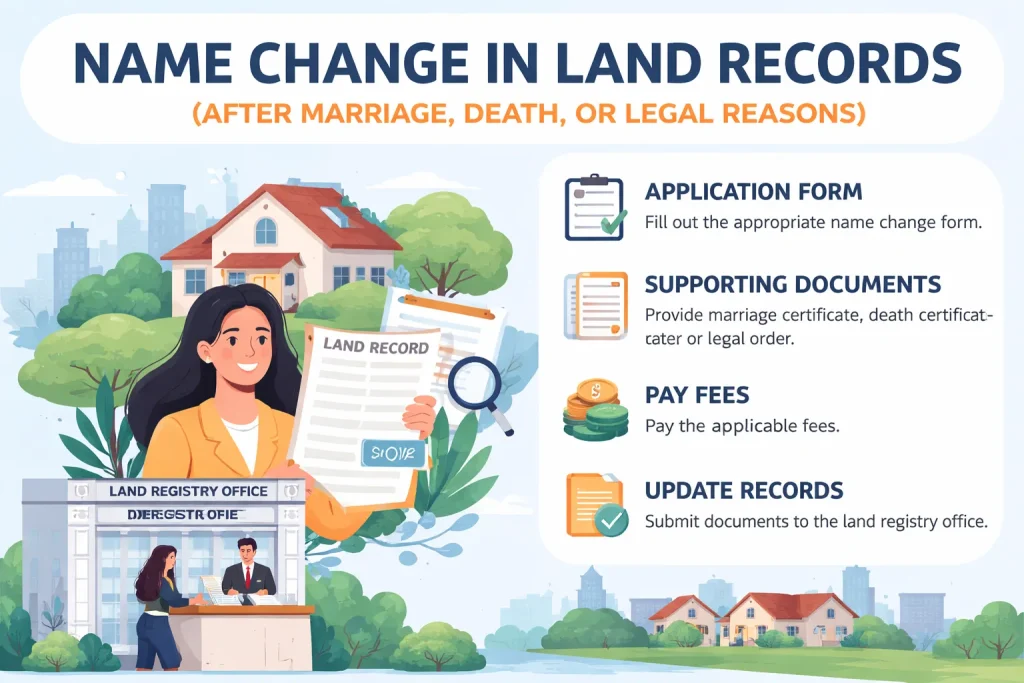
Name Change in Land Records(After Marriage, Death, or Legal Reasons)
Submit the required documents at the Taluk or VAO office with the update form and fee.After verification, the new record is issued.
Documents Required:
Marriage: Marriage certificate, address & ID proof, husband’s Patta (if merging).
Death: Death certificate, heirs’ ID proof, tax/water/electricity bills, succession/legal heir certificate, property deed.
Legal Reasons: Court order, sale/title deed, ID & address proof, Gazette notification, encumbrance certificate.
Timeline
Marriage name update: 2–3 weeks
Name change in land records is essential after marriage, death, or legal reasons to ensure accurate ownership details, avoid disputes, and maintain updated property records for smooth transactions.
Legal heir transfer (after death): 3–6 weeks
Complicated/court cases: Several months
Process:
Just follow the following steps:
Visit local revenue office or online portal
Fill application form correctly
Attach required documents
Submit application for verification
Authorities review documents
Field verification may be conducted
Approval is processed by officials
Name is updated in records
Updated Patta is issued
Verify updated details online
How Banks Use Land Documents for Land Loans and Mortgages
Confirms legal ownership of the property.
Helps banks assess land value and eligibility for loans.
Survey numbers and land classification ensure the property is free of encumbrances and valid for collateral.
Common Myths in Land Ownership
Owning land doesn’t automatically guarantee legal protection without proper documentation.
Physical possession or informal agreements alone cannot prove ownership; official documents like Patta Chitta are essential.
Some assume land transactions are complete once bought, but records must be updated and taxes paid.
Ignoring the land title history can lead to future disputes.
Legal ownership requires compliance with local regulations and proper documentation, not just possession.
Learn more about land ownership myths and how to navigate them effectively on our website.
How to Check Old Tamil Nadu Property Records (Before the Digital System)
Jst follow these steps:
Go to the local Tahsildar or Sub-Registrar office.
Ask for Patta, Chitta, or other documents using survey number and village name.
Check with village panchayats for corrections or additional details.
Request official copies for verification.
Seek legal assistance if needed.
Contact Details / Support
Commissionerate of Survey and Settlement, Government of Tamil Nadu
No.1, Survey House, Kamarajar Salai, Chepauk, Chennai – 600005
1100
dir-sur@nic.in
Tamil Nadu e-Services Portal https://pattaachitta.net/
Video Guide
FAQs
Final Words:
Patta Chitta is an official Tamil Nadu land ownership document available online via the Tamil Nadu e-Services Portal. It verifies ownership, land details, and classification, essential for property transactions, loans, and dispute resolution. Users can view, download, or update records and check TSLR Extracts or FMB Sketches using apps or QR codes. With proper documentation and quick processing, Patta Chitta ensures transparency, legal protection, and secure property management for all landowners.